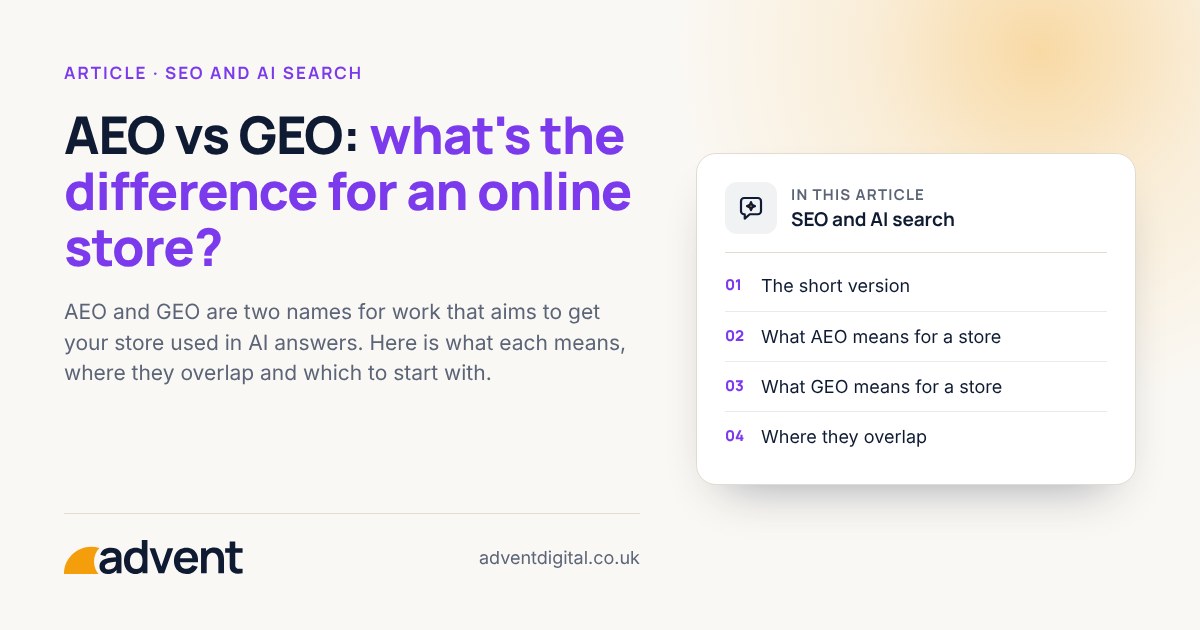
AEO (answer engine optimisation) is about getting your pages used as the direct answer to a question. GEO (generative engine optimisation) is about getting your brand named by AI assistants. They overlap, and for most online stores the sensible order is AEO first. This article is part of our Shopify SEO: the complete guide.
The short version
| AEO | GEO | |
|---|---|---|
| Aim | Your page is used as the answer | Your brand is named or recommended |
| Tied to | Your own pages and how they rank | What is said about you across the web |
| Typical question | “Can I wear this jacket in heavy rain?” | “Which shops sell good walking jackets?” |
| Main lever | Clear, answer-first pages | A clear, consistent brand with genuine mentions |
These are working definitions. The terms are new, and different people use them in different ways. Neither Google nor the main AI providers use these terms themselves. Google talks about its “AI features” in Search.
What AEO means for a store
AEO is mostly good page writing:
- Put a short, accurate answer at the top of the page, then the detail.
- Cover the questions customers really ask: sizing, delivery, returns, materials, comparisons.
- Use clear headings so a reader, or a tool, can find the answer quickly.
- Add structured data only where it matches what is on the page. Google’s guidance is that no special markup is needed for its AI features. Product, review and organisation markup still help ordinary search.
Because AI summaries and search answers tend to come from pages that already do well in ordinary search, AEO leans on ordinary SEO. Google says its AI features in Search draw on the same systems as its ordinary results.
What GEO means for a store
GEO is about being understood and mentioned as a brand:
- Say plainly what you sell, who it is for and how you differ.
- Keep your name, details and descriptions consistent wherever they appear.
- Earn genuine reviews, press and trade mentions. Do not buy or invent them.
Much of this sits outside your own site, so it takes longer and is harder to measure. For more on what is and is not known, read How AI search tools choose which stores to mention.
Where they overlap
Both rest on the same foundation: accurate pages that can be found and understood, and a store people trust. If you do one properly you will often help the other. The difference is mainly in where you spend your effort.
Which should you start with?
- Start with AEO if your customers ask questions before they buy and your pages are sound. It is work on pages you control.
- Add GEO once the basics are in place, and you want to be named when someone asks for a recommendation.
- Fix ordinary SEO first if your pages are slow, thin or not indexed. Neither AEO nor GEO will rescue them.
Nobody can promise that any step will get you into an AI answer. Be wary of anyone who does.
What to avoid
- Paying for guaranteed mentions in AI tools.
- Adding questions nobody asks just to fill an FAQ section.
- Writing stiff, repetitive text for machines. It reads badly for shoppers.
- Judging progress from a few questions you typed in yourself.
From experience
Customers have questions, and the brand that answers them is often the one they buy from. Answer engines look for the same thing: clear, specific answers, such as a well-written FAQ section, that they can pick up and show.
Where to get help
Our answer engine optimisation service starts with the questions your customers really ask, and is plain about what is unproven.
Related services that often go with it:
- Generative engine optimisation, for being named and cited by AI assistants.
- SEO for ecommerce, for the collection and product page work this rests on.
- Local SEO, if your customers search for something near them.
You may also like Shopify collection page SEO: what to fix first.