Nobody outside the AI providers knows exactly how their tools choose which stores to mention, and anyone who says otherwise is guessing. What you can do is make your store clear, consistent and well covered elsewhere, which helps in ordinary search as well. This article is part of our Shopify SEO: the complete guide.
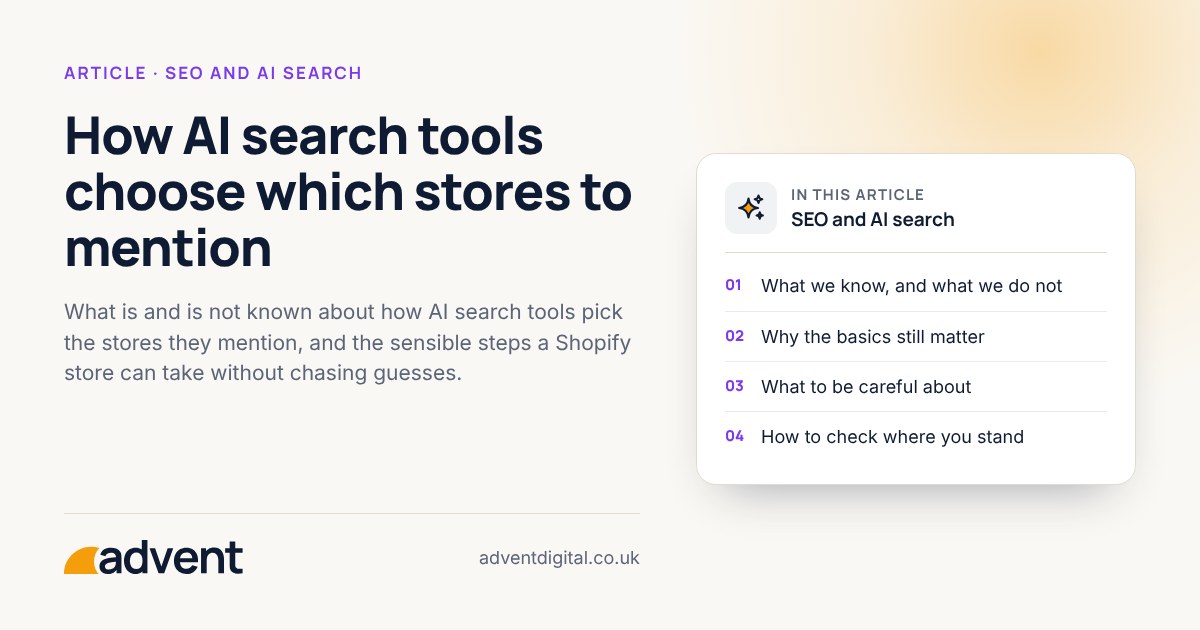
What we know, and what we do not
What is reasonable to say:
- These tools draw on information about your brand from a range of places, not only your own website.
- Some tools search the web at the time of the question. Others rely mostly on what they learned in training. Most of the main assistants, including ChatGPT, Gemini, Copilot, Perplexity and Claude, can now search the web when a question needs it.
- Providers do not publish a ranking formula, and results can differ from one question, or one day, to the next.
What we cannot say: that any particular step will get you mentioned. Treat any promise of that kind with caution.
Why the basics still matter
Whatever the method, a tool can only describe what it can find and understand. That points to a few plain steps.
Say clearly what you sell and who it is for
Write your home page, collection pages and about page so a stranger could summarise the store in a sentence. Avoid vague claims. Name the products, the audience and what makes you different.
Keep your details consistent
Use the same brand name, address, product names and descriptions wherever they appear: your site, marketplaces, social profiles and directory listings. Mixed-up details make it harder for anyone, human or machine, to be sure who you are.
Answer real questions
Buying guides, size guides, delivery and returns pages, and straightforward answers to common questions give tools something accurate to quote. Write them for shoppers first.
Be mentioned by others
Genuine reviews, press, trade listings and links from relevant sites show that you exist outside your own pages. Do not buy these, and do not invent them.
Keep the technical side sound
Pages that load, can be reached by search engines and have correct product details are easier to use. Most current Shopify themes add basic product markup by default.
What to be careful about
- Do not pay for tools or services that promise guaranteed mentions in AI answers.
- Do not stuff pages with phrases written for machines. They read badly and put shoppers off.
- Do not judge progress from a handful of questions you typed in yourself. Answers vary, and that is a weak test.
How to check where you stand
Keep it simple and honest:
- Write a short list of questions a customer might ask about what you sell.
- Ask them in the tools you care about, and note whether your store is mentioned and whether the description is accurate.
- Repeat monthly, on the same questions, and record what you see.
- Fix anything that is wrong at the source, such as an outdated listing or an unclear page.
Treat the results as notes, not measurements.
From experience
People are using generative AI to help them decide what to buy. Optimising your website with GEO in mind gives it a better chance of being suggested when someone is weighing up a purchase.
Where to get help
Our generative engine optimisation service focuses on the sensible steps above and is plain about what is unproven.
Related services that often go with it:
- Answer engine optimisation, for writing pages that can be used as direct answers.
- SEO, for the wider search work this rests on.
- Brand strategy, for making clear what your brand stands for and how to say it consistently.
You may also like Shopify collection page SEO: what to fix first.